Every CFO knows that sinking feeling. You’ve spent hours building the “perfect” budget in Excel. Clean formulas. Logical structure. Everything rolls up correctly.
Then someone accidentally deletes a row. A department head adds a column that breaks your VLOOKUP. And suddenly you’re spending your weekend rebuilding what should have been a five-minute update.
The real question isn’t whether Excel works for budgeting. It’s whether you can afford what it’s costing you.
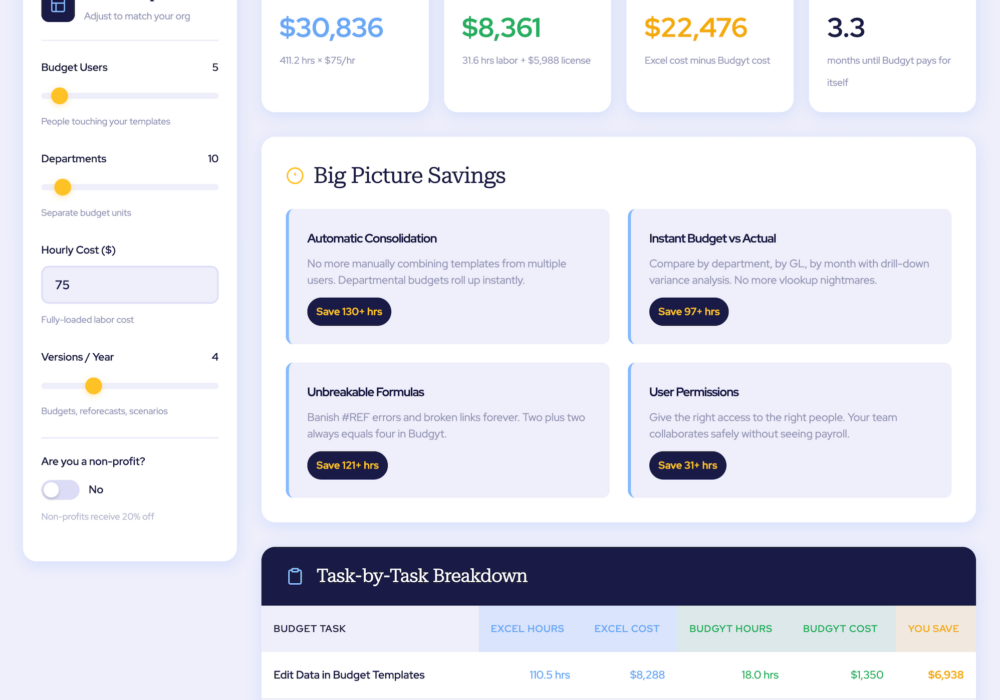
We analyzed the actual time finance teams spend on budget tasks in Excel versus purpose-built budgeting software. For a typical mid-sized organization with 6 users managing 10 departments, the numbers are staggering. These calculations use a $75/hour fully-loaded labor cost, though your specific rate may vary.
Excel budgeting costs $30,836 per year in labor alone.
That’s 411 hours annually – more than 10 full working weeks – spent on tasks that shouldn’t require that much time. And that doesn’t even count the career risk when formulas break during board meetings.
Let’s break down the major time drains. These aren’t theoretical – these are real tasks your team faces every budget cycle:
1. Editing Budget Data: 110.5 hours per year ($8,288)
Users must navigate to the proper tab and file, being careful not to delete or edit the wrong data. One keystroke can delete critical information. Reconsolidating data and verifying that links still work and formulas weren’t tampered with takes massive amounts of time.
With Budgyt: 18 hours ($1,350) – saving $6,938
Built-in spreading tools and formulas that can’t be accidentally adjusted. Double data entry verification ensures increased accuracy.
2. Creating and Maintaining Formulas: 80 hours per year ($6,000)
Time-consuming setup of formulas that are often hard to follow. Creating colour-coded data entry cells. Ensuring enough data rows exist for all users. You must be an Excel expert to create formulas and train users properly.
With Budgyt: 4 hours ($300) – saving $5,700
Managed through the formula builder. Time spent building formulas is minimal as it’s seamless across any number of P&Ls. Users can be limited to data entry, while admins control formula structure.
3. Monthly Budget-to-Actual Reporting: 48 hours per year ($3,600)
Summary data is entered manually or with advanced VLOOKUP formulas. Manually controlling access to data. Getting detailed information is nearly impossible.
With Budgyt: 1 hour ($75) – saving $3,525
Import data from any accounting software within minutes. All budget-to-actual reporting is immediate and accurate. No manual data entry required.
4. Verifying Nothing Broke: 33.3 hours per year ($2,500)
Verify each formula is still working and accessing the right data every time a user touches the file. One inserted row can cascade errors through your entire budget.
With Budgyt: 1 hour ($75) – saving $2,425
Rows can’t be thrown off. No need to verify because the system is built to protect against this.
5. Finding and Auditing Numbers: 25.3 hours per year ($1,899)
Searching for data in Excel is difficult. No search function, and hard to audit or trace formulas – especially if you’re in a board meeting. Verifying and proving numbers is time-consuming.
With Budgyt: 1 hour ($75) – saving $1,824
Find data instantly as everything is clickable. Drill down and navigation are straightforward. Search by any description term to locate what you need.
Here’s what it actually costs to run your budgeting process:
| Excel Budgeting | Annual Cost |
| Labor Hours | 411 hours |
| Labor Cost | $30,836 |
| Software Licence | $0 |
| Total Annual Cost | $30,836 |
Purpose-built budgeting software eliminates 92% of this labor waste.
This isn’t about replacing Excel with a more expensive Excel. It’s about eliminating the problems Excel creates:
Unlimited users included. No per-seat fees. No scaling penalties. Just collaborative budgeting that actually works.
Those 400+ hours of wasted labor per year? That’s just the measurable cost. What about the 2am panic attacks when you find circular references? The board meeting where someone gleefully finds “that mistake”? The weekend you lost rebuilding formulas that shouldn’t have broken?
Your job is literally on the line every time you present a budget with 8,000+ formulas. One #REF! error in front of the board, and your credibility evaporates.
Over 350 CFOs have switched to Budgyt because they were tired of accepting that risk. They wanted to budget with confidence and present without fear.
Can you afford not to switch?
You manage millions of pounds. You make decisions affecting dozens of employees. You report to boards with fiduciary responsibility.
Yet you’re still budgeting with software that forces you to choose between doing everything yourself (burnout) or sharing files with your team (career-threatening risk).
Professional financial management deserves professional tools.
The $30,836 annual cost shown is based on a typical mid-sized organisation with 6 users managing 10 departments. Your situation might be different.
Find out more about switching from Excel or our Excel vs Budgyt Cost Calculator to see your organisation’s specific savings based on your number of users, departments, and hourly costs.
You manage millions of dollars. You make decisions affecting dozens of employees. You report to boards with fiduciary responsibility.