
Formulas that stack, payroll that splits
Stacked formulas, payroll allocation across grants and full activity audit trails are missing in Martus. Budgyt handles them natively. Because “we had to do that part in Excel” isn’t an answer.
Martus was built for nonprofits. So was Budgyt. But when your budget gets complicated – when a grant allocation needs stacking or an auditor wants to trace a number – Martus falls short, and Budgyt delivers. Full features, one nonprofit price, no workarounds.














Stacked formulas, payroll allocation across grants and full activity audit trails are missing in Martus. Budgyt handles them natively. Because “we had to do that part in Excel” isn’t an answer.
Martus keeps core capabilities like cash flow forecasting, deeper scenario planning, and advanced reporting limited to higher pricing tiers. Budgyt ships them standard in the nonprofit plan.
For deeper variance drill-downs and scenario work, Martus users often end up exporting data to spreadsheets. Budgyt keeps everything live and connected, with audit lineage intact.
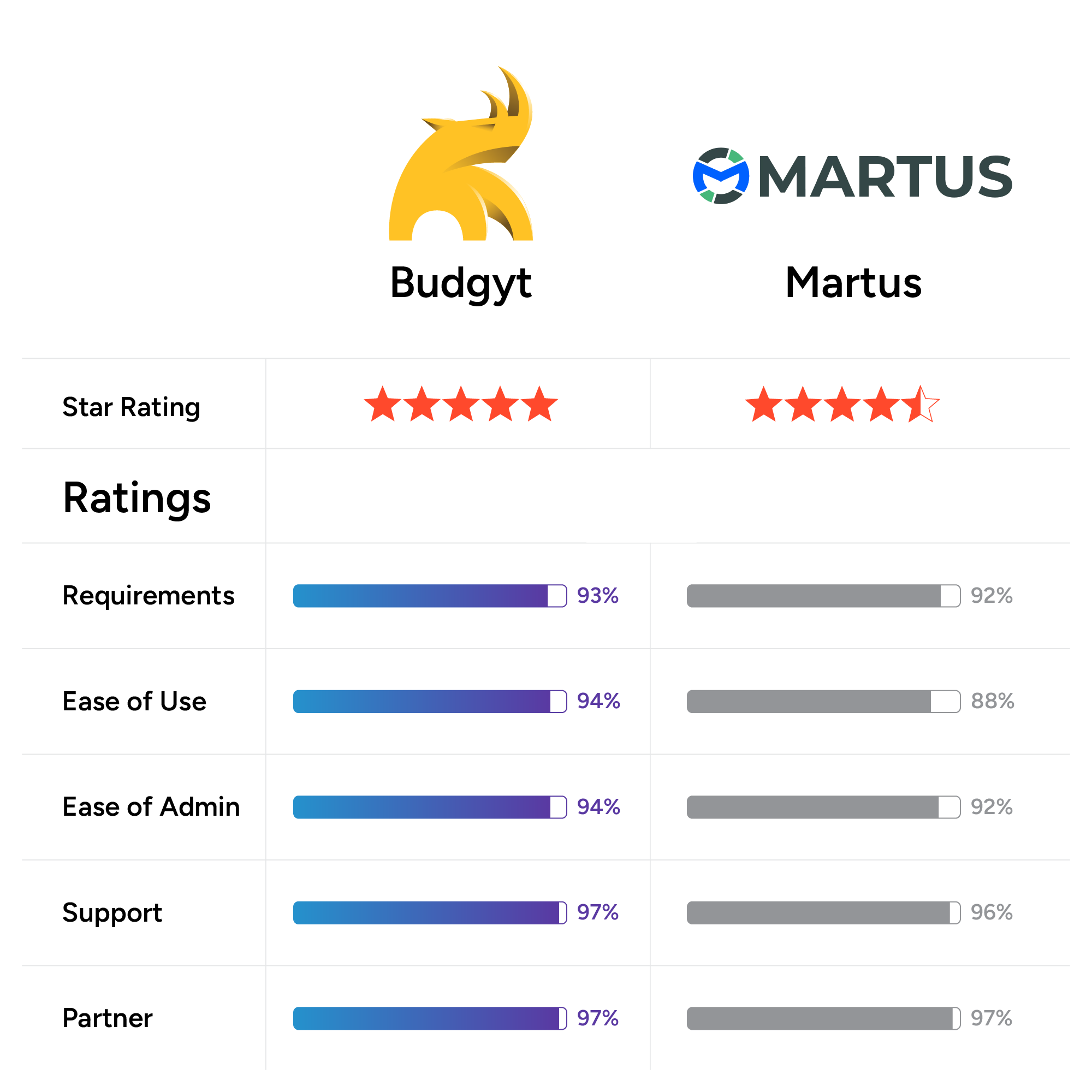
Budgyt: 4.8/5 ★ | Martus: 4.7/5 ★
Budgyt outperforms Martus on the G2 categories that matter most for nonprofits running grants, programs, and multiple entities, including:
With Budgyt, yes. Everything you need for your nonprofit is included as standard. Martus limits some key features to higher Plus and Premium tiers (with the costs quickly adding up).
Budgyt was built for this (and ranks higher on G2). Stack formulas, split payroll across grants by category, dimension and department, and roll up programs into entities without reaching for spreadsheets.
Only with Budgyt. Martus lacks search functionality and doesn’t support complex formulas, so users have to export to Excel. Every export breaks audit lineage and adds workload.
Budgyt thrives here, Martus struggles. When a grant shifts or a major donor delays, you need to re-forecast the same day, not next quarter. Budgyt’s features work fast as standard.

Budgyt provides our leaders with an easy, self-service interface for their financial data. It empowers them to do their own analysis and saves the finance team a lot of time answering questions.

We rely on a flexible approach to managing our finances, so it is critical to have data organized and presented the way we need it. Budgyt is highly customizable and can fit most, if not any, account structure.

We adopted Budgyt as a budgeting solution to replace Excel, but it has become so much more than that. It’s our tool of choice for budgeting, forecasting, and analysis, and it is incredibly accessible and easy.
| What You Need | Budgyt | Martus |
|---|---|---|
| G2 rating | 4.8/5 — 103 reviews | 4.7/5 — 58 reviews |
| Features | ||
| Pricing structure | One plan, all core features included | Tiered: Essentials / Plus / Premium |
| Cash flow forecasting | Included | Premium tier only |
| Advanced scenario tools | Included | Higher tiers only |
| Implementation | ||
| Time to go live | ~2 months (based on G2 users) | 2+ months (based on G2 users) |
| Capabilities | ||
| Complex formula support | Stacked formulas and multi-dimensional payroll allocation, natively | Neither supported - workarounds needed |
| Multi-entity rollups | Three-tier: department, region, entity | Narrower - workarounds often needed |
| Activity audit trail | Full, in-platform | Not available |
| Analysis | ||
| In-platform analysis | Variance drill-down and search | Excel export required |
| Forecasting and what-ifs | Rolling forecasts and unlimited scenarios, included | Weaker G2 scores, deeper tools gated by tier |
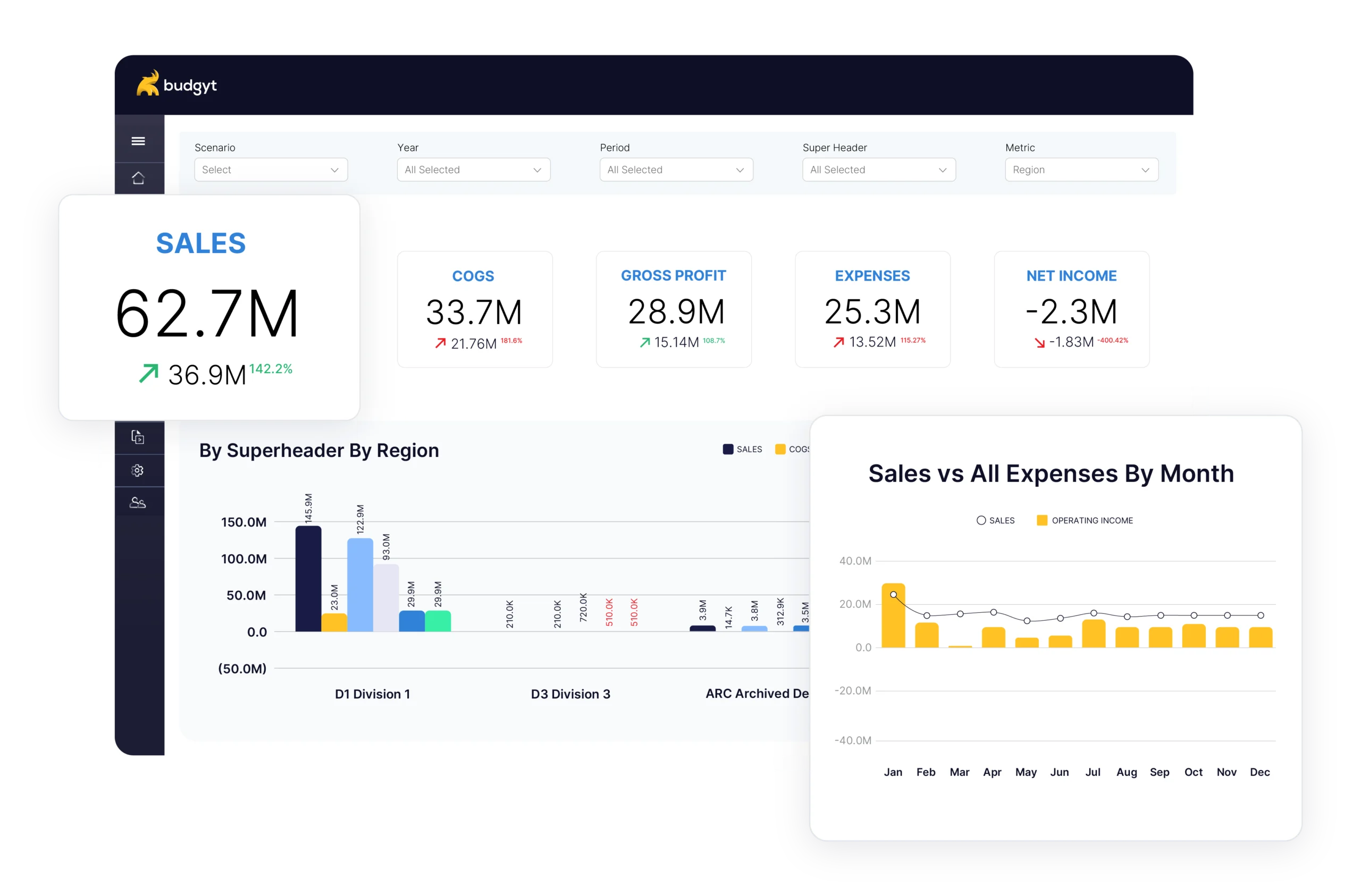
Budgyt. Both platforms serve nonprofits. The difference is speed, depth, and how much you pay for the capabilities you actually need. Budgyt rates higher on G2 overall (4.8 vs 4.7 as of April 2026), includes advanced features in the base plan, and G2 users consistently report faster implementation and faster ROI.
Budgyt averages around 2 months on G2. Martus averages longer on the same G2 metric. Martus claims the initial setup is fast, but G2’s user-reported “time to go live” reflects the full path to a working, deployed budget. For a nonprofit on a fiscal-year clock, the gap is real.
Yes, with Budgyt. Budgyt was designed so department heads, program directors, and grant managers can input and review budgets without needing accounting expertise. G2 reviewers flag that Martus’s complexity makes it harder for non-accountants to navigate.
Not natively. Budgyt scores higher on multiple entities and data consolidation. For nonprofits managing grants, programs, and separate legal entities, that gap is where Martus customers tend to reach for spreadsheets or upgrade tiers.
No. Martus packages its offering into Essentials, Plus, and Premium tiers. Capabilities like cash flow forecasting, balance sheet management, and advanced scenario tools sit in the upper tiers. Budgyt includes these in the core nonprofit plan.
Partially. Basic scenario planning is available in Martus. G2 reviewers score Budgyt higher on rolling forecasts and what-if modeling, and Martus’s deeper cash flow and forecasting tools are gated behind its Premium tier.
Budgyt lets you drill from dashboard to transaction inside the platform. Martus users more often export data to Excel for the same analysis. That export breaks lineage, adds reconciliation work, and slows month-end. Budgyt’s variance analysis scores higher on G2.
Budgyt offers one nonprofit plan at a transparent price and a nonprofit discount. Martus prices across three tiers (Essentials, Plus, Premium) with features split across them, so true cost depends on which capabilities you need. When evaluating, ask both vendors for a full quote that covers implementation, users, entities, and every feature you’ll actually use.
With Budgyt, the platform scales without re-implementation. Add an entity, a grant, a program, or a department, and the database adjusts. Users consistently rate Budgyt higher than Martus on self-service, versioning, and partnership on G2, which matters most when your organization changes faster than your software can keep up.
Full grant allocation, multi-entity rollups, variance drill-down, and rolling forecasts, included. No tier upgrades, no missing features, no exports back to Excel.