Every vendor in finance technology is racing to slap an AI badge on their product. Microsoft Copilot promises to revolutionize your spreadsheets. ChatGPT plugins claim they can analyze your budget in seconds. And if you’re a CFO still running your budget in Excel, you’re probably wondering: will any of this actually help?
AI is powerful technology. It can perform data analysis and pattern recognition that would have seemed like science fiction 10 years ago. But if your budgeting process is built on Excel, AI isn’t going to save you. The problems with Excel budgeting are architecture problems, and no amount of artificial intelligence can fix bad architecture.
AI can help with certain finance tasks. Copilot can write formulas and spot anomalies inside a spreadsheet. Upload your budget to ChatGPT or Claude and you can get variance summaries, trend analysis, or scenario comparisons in seconds. That’s real value.
But none of those capabilities address the actual reasons Excel budgeting fails.
Copilot still operates inside a spreadsheet where any user can break a formula. When you upload a file to ChatGPT, you’re working from a static snapshot, a copy of the budget as it existed at that moment. The AI has no way of knowing if the version you uploaded is current, if the formulas were intact when you exported it, or if three other people have made changes since. A typical budget has over 8,000 rollup formulas, and no way to verify any of them. If the data is already broken, the AI just gives you a polished analysis of broken data.
Nobody in the AI hype cycle wants to talk about this: putting AI on top of a broken Excel model just gives you faster wrong answers.
If your underlying data is fragmented across versions, your AI analysis will be based on the wrong version. If your formulas are broken, AI will process the broken outputs and present them with confidence. If your consolidation is unreliable, AI will summarize unreliable numbers and make them look polished.
That last part is arguably the most dangerous outcome. AI is very good at making things look professional and authoritative. A well-formatted AI-generated summary of your budget variance analysis looks great in a board pack. But if the numbers feeding that summary came from a spreadsheet where someone accidentally deleted a row in the payroll tab three weeks ago, you’ve now got a beautiful, convincing, completely wrong report sitting in front of your directors.
This isn’t hypothetical. Finance teams deal with exactly this kind of silent data corruption constantly. Without AI, broken numbers at least look rough and unfinished, which prompts people to double-check. With AI smoothing everything into a polished deliverable, the errors become invisible. The instinct to verify something that looks off disappears.
A spreadsheet was never designed to be a database. It doesn’t enforce data integrity, manage concurrent users, maintain relationships between entities, or create audit trails.
These are solved problems. They’ve been solved for decades. Every accounting system you use is built on a database. Your ERP runs on one. Your CRM runs on one. Nobody would dream of running their general ledger in Excel. The budget gets a pass for some combination of familiarity, inertia, and the (understandable) fear that dedicated budgeting software means six-figure contracts and six-month implementations. That fear made sense ten years ago.
What should concern you more is the compounding cost of staying put. Every budget cycle, your team spends days, sometimes weeks, on manual consolidation, formula repair, and version reconciliation. That’s data janitorial work, not analysis. And AI isn’t going to automate it away because the mess is structural.
AI is a useful tool for financial analysis and planning. But the sequence matters. AI layered on top of solid architecture changes how a finance team operates. AI layered on top of broken spreadsheets is a liability.
When your budgeting data lives in a proper database, with enforced formulas that can’t break, built-in version control, real-time collaboration, and complete audit trails, AI can do what it’s actually good at: surface patterns, flag anomalies, accelerate analysis, and help you make better decisions faster. You wouldn’t build a skyscraper and then try to fix the foundation afterwards. You wouldn’t run your general ledger in a spreadsheet and hope AI would catch the posting errors. The same principle applies here.
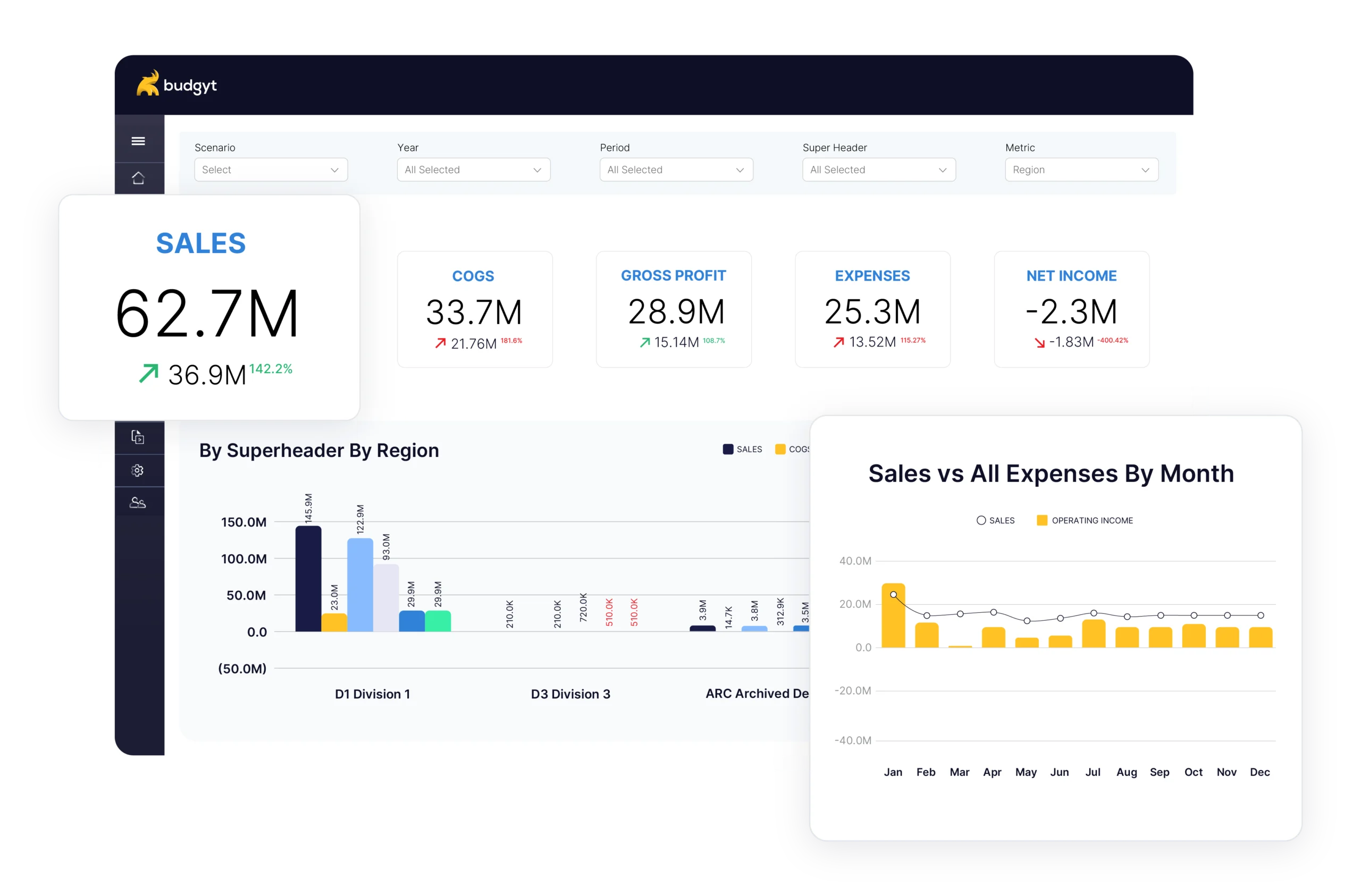
At Budgyt, the platform runs on a database foundation. Formulas are unbreakable. There are no #REF! errors to fix because the architecture physically prevents them. Version control is built in. Multiple users collaborate in the same system simultaneously without risk. Every number has an instant audit trail you can click into.
Budgyt also has AI. Budgyt CoPilot sits on top of this database foundation, giving users instant access to a knowledge base of over 500 articles and 150 videos. It makes a solid system more accessible and more useful. That’s a different proposition from trying to patch over structural flaws.
If you’re evaluating AI tools for your budgeting process, that’s a smart instinct. AI will play a role in the future of financial planning. But if your budget still lives in Excel, buying an AI add-on is like putting a turbocharger on a car with no engine.
Move to a database foundation where formulas can’t break, where version control is automatic, where your team can collaborate without risk, and where every number is defensible in seconds. Then bring AI into the picture. Your board needs numbers they can trust, not faster analysis of broken ones.
You manage millions of dollars. You make decisions affecting dozens of employees. You report to boards with fiduciary responsibility.