When your staff are split across multiple grants, a wrong allocation can cost you the funding. When a grant auditor asks how you calculated the $47,000 in payroll costs for the youth program, you need to be able to show them. That’s the risk that sits underneath every nonprofit budget built in Excel. And most of the software built to solve it runs $20,000 to $50,000 a year, enough to trigger a formal procurement process before you can even get started.
This guide looks at seven budgeting tools for nonprofits, comparing them on features, G2 ratings, pricing, and fit for grant-funded operations.
| Tool | G2 Rating | Starting Price | Excel-Based? | Grant Allocation | Unlimited Users | Best For |
|---|---|---|---|---|---|---|
| Budgyt | 4.8/5 | $4,788/year | No | Yes, across grants/programs | Yes | Multi-dept nonprofits with grant allocation needs |
| Martus | 4.8/5 | $6,650/year | No | Partial (gaps at dimension level) | No (5-user packs) | Smaller nonprofits, with simple financing |
| Datarails | 4.6/5 | $15,000/year | Yes | Limited | No | Finance teams that want to keep working in Excel |
| Vena | 4.5/5 | $10,000/year | Yes | No (cost center allocation not supported) | No | Mid-market orgs with strong Excel expertise |
| Jirav | 4.7/5 | $16,000/year | No | No (requires Excel workaround) | No | FP&A-driven SMBs and advisory firms |
| Centage | 4.2/5 | $21,000/year | No | Yes (personnel module) | No | Larger nonprofits ($25M+ budget) |
| Prophix | 4.4/5 | $50,000/year | No | Yes (workforce module) | No | Large nonprofits with enterprise FP&A needs |
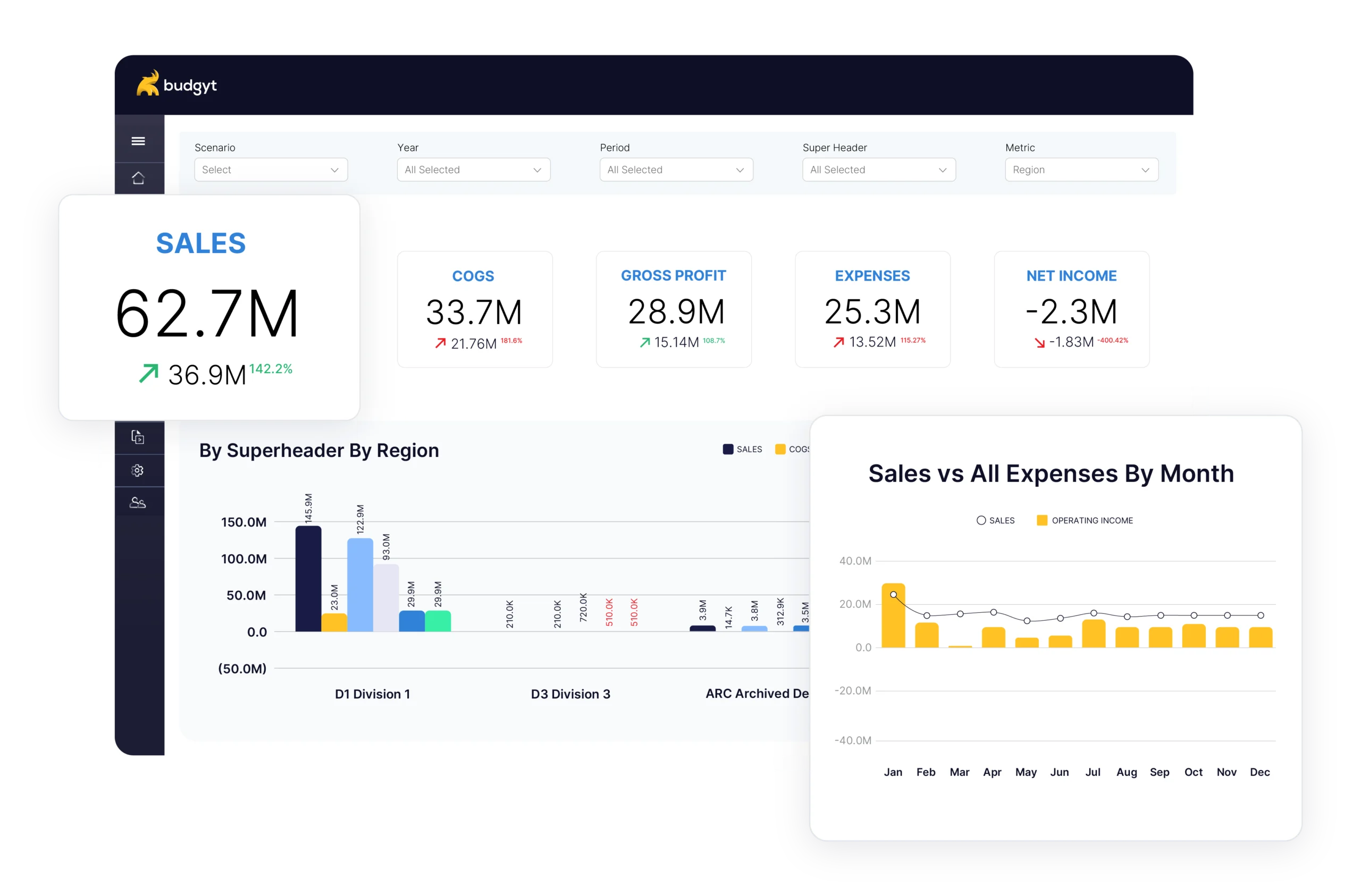
Budgyt is a cloud-based, database-driven budgeting platform built for mid-sized organizations, with roughly half of its customer base in the nonprofit sector. It replaces Excel entirely, eliminating formula risk at the foundation rather than managing around it.
Key features for nonprofits.
Things to know. Budgyt is a budgeting platform, not an accounting system. Organizations needing fund accounting or donor management in the same tool will need a separate system alongside it.
G2 rating and review snapshot. 4.8/5 on G2. #1 on TrustRadius for budgeting software. 4.9/5 on Capterra. Ease of setup: 9.0/10 on G2. Time to ROI: 7 months.
Best for: Nonprofits with multi-grant payroll complexity, multi-department budgeting, and a need for unlimited contributors at a predictable flat rate.
Martus is a cloud-based budgeting and forecasting platform serving nonprofits, faith-based organizations, and associations. It connects to over 25 accounting systems including Sage Intacct, Blackbaud Financial Edge NXT, and QuickBooks.
Things to know. User licenses are sold in five-user packs, so costs scale with the number of people involved in the budget process. Personnel budgeting, scenario planning, and custom reporting require the Plus tier above the $6,650 base price. Some users have noted limitations in payroll allocation across multiple dimensions and cost centers.
G2 rating and review snapshot. 4.8/5 on G2 with 59 reviews. G2 Spring 2026 Leader in Budgeting and Forecasting. Capterra: 4.6/5.
Best for: Faith-based organizations, churches, and associations with simpler grant structures and smaller contributor groups.
Datarails is an Excel-native FP&A platform that automates data consolidation and reporting while keeping spreadsheets as the working interface.
Things to know. Because Datarails runs on Excel, it keeps the formula and mapping table maintenance that comes with spreadsheet-based budgeting. Adding new accounts or departments requires manual updates to mapping tables. Users frequently cite the need for ongoing external support even after becoming proficient.
G2 rating and review snapshot. 4.6/5 on G2 with 281 reviews. Strong scores on custom reporting (9.5) and quality of support (9.5).
Best for: Finance teams that want to automate consolidation while keeping their existing Excel-based workflows.
Vena is a mid-market FP&A platform built on Excel, adding database-driven workflow, audit trails, and version control on top of spreadsheets. Nonprofit discounted pricing is available.
Things to know. Vena runs on Excel, which means your team is still working in spreadsheets to build and manage budgets, with all the version control, formula, and collaboration limitations that come with it. Adding departments or making organizational changes typically requires paid consultant support. Implementation runs two to five months. The platform is not compatible with Macs.
G2 rating and review snapshot. 4.5/5 on G2 with 371 reviews. 2025 Gartner Magic Quadrant Challenger for Financial Planning Software. Time to ROI: 20 months on G2.
Best for: Mid-market organizations with strong Excel expertise, dedicated FP&A staff, and the budget for a longer implementation.
Jirav is a cloud-based FP&A platform targeting small to mid-sized businesses and accounting advisory firms, with strong visual reporting, scenario planning, and integrations to major accounting systems and HCM providers.
Things to know. Payroll and overhead allocations need to be built outside the platform and uploaded, rather than handled natively. Formulas are not stackable, which limits multi-layered grant allocation calculations. Pricing starts at $16,000 per year.
G2 rating and review snapshot. 4.7/5 on G2 with approximately 130 reviews. Highest quality of support score in this comparison at 9.7/10.
Best for: FP&A-driven SMBs and accounting advisory firms that prioritize visual reporting and scenario planning over grant allocation depth.
Centage is a formula-free, cloud-native FP&A platform targeting mid-market organizations. It was built with healthcare, education, and nonprofit organizations in mind and has a dedicated nonprofit industry page with named customers.
Things to know. Centage starts at $1,750 per month with typical contracts running $18,000 to $40,000 annually. There is an additional set-up fee and implementation takes four to six weeks. Only 26 G2 reviews exist, making it harder to evaluate at scale.
G2 rating and review snapshot. Approximately 4.2/5 on G2 with 26 reviews. TrustRadius: 9.4/10. Capterra: 4.0/5.
Best for: Larger nonprofits with annual budgets above $25 million and complex three-statement reporting requirements.
Prophix is a full financial performance platform covering budgeting, forecasting, consolidation, close management, and ESG reporting. It serves over 2,500 customers globally including major nonprofits such as Feeding America, Susan G. Komen, and Goodwill Industries.
Things to know. Verified transaction data shows a minimum contract of $50,000 per year, with an average deal of $205,000 annually. Implementation typically takes eight or more weeks and frequently involves third-party consultants at additional cost.
G2 rating and review snapshot. 4.4/5 on G2 with 216+ reviews. G2 2025 Best Software Award winner. TrustRadius: 8.2/10.
Best for: Large national nonprofits with 500-plus employees, multi-entity structures, and the internal resources for an enterprise platform.
If staff salaries need to be split across multiple grants by percentage each month, confirm whether the tool handles this natively or requires an external workaround.
Per-user pricing escalates quickly when program directors, department heads, and grant managers all need access. Flat-rate pricing is a meaningful advantage for nonprofits where broad participation is the goal.
Most tools here integrate with QuickBooks, Sage Intacct, Blackbaud Financial Edge NXT, NetSuite, and Microsoft Dynamics 365. Confirm any integration you depend on is current and validated before committing.
Budgyt starts at $399 per month. Martus starts at $6,650 per year. Centage starts at $21,000 per year. Jirav starts at $16,000 per year. Prophix starts at $50,000 per year.
For nonprofits with multi-department budgets, grant allocation complexity, and a finance team that needs program directors involved in the process, Budgyt offers the most complete fit: database-driven reliability, payroll allocation that updates when funding changes, unlimited users at a predictable flat rate, and review scores: TrustRadius #1, 4.9/5 on Capterra, that reflect how it performs in practice.
You manage millions of dollars. You make decisions affecting dozens of employees. You report to boards with fiduciary responsibility.